 Polya
Join the waitlist
Polya
Join the waitlist
Never get stuck on a problem again
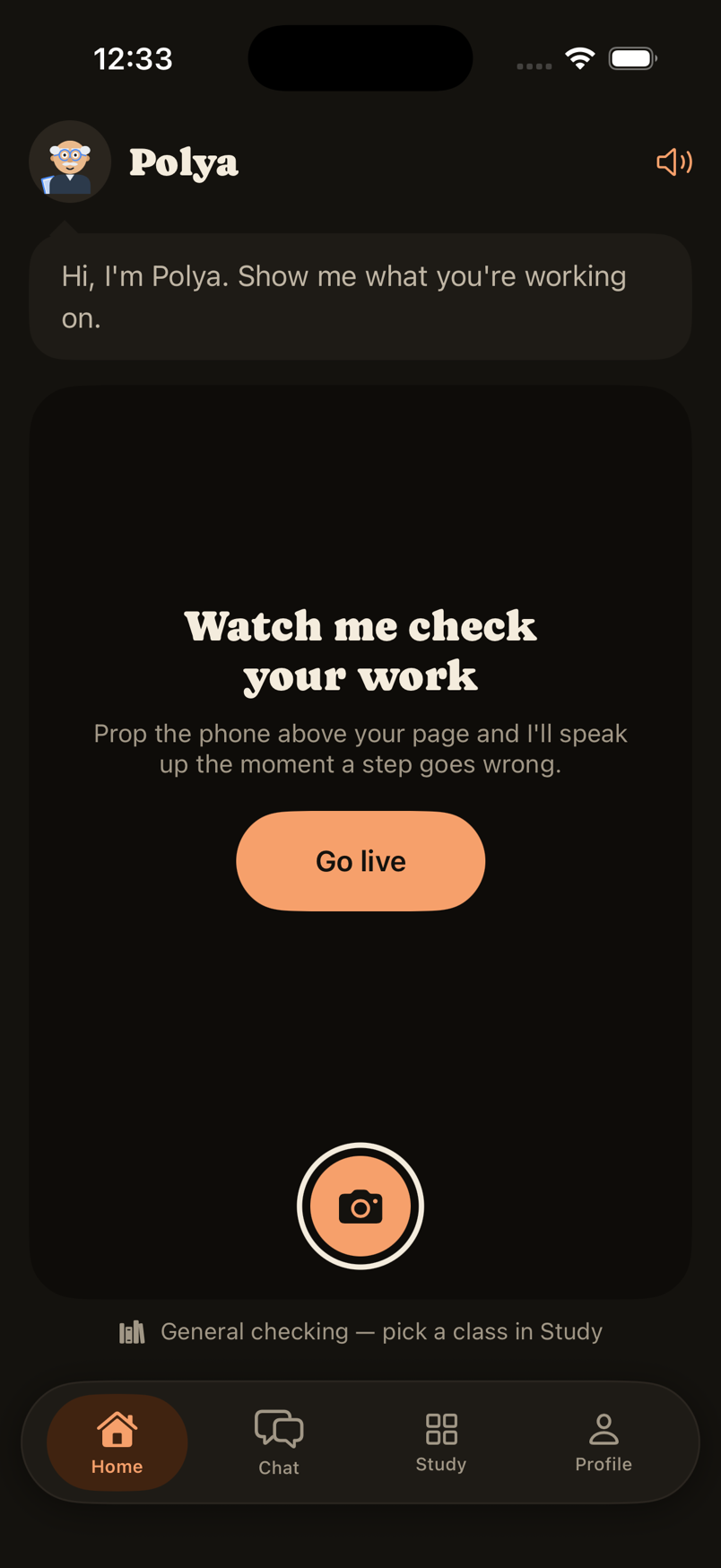
Polya is your 24/7 available live AI tutor.
Prop your phone above the page and press Go live. Polya watches through the camera while you write and speaks up the moment a step goes wrong — so you find out at line six, not at the bottom of the page. Talk to him out loud; you never touch the phone. Nothing to book, no one to wait for, and he is still there on Sunday night.
He is not on the App Store yet. Free to join, no card, one email when he ships — and people on the list get the launch price, 20% off; see pricing.
Open at every hour you actually do homework
The problem with a tutor is not that they are bad at it. It is that the hour you need one is Sunday at midnight, and the hour you can book is Wednesday at four. Polya has no calendar.
He is not a replacement for a person who knows you. He is what you have instead of nobody, at the hour there is nobody.
Every line gets a verdict
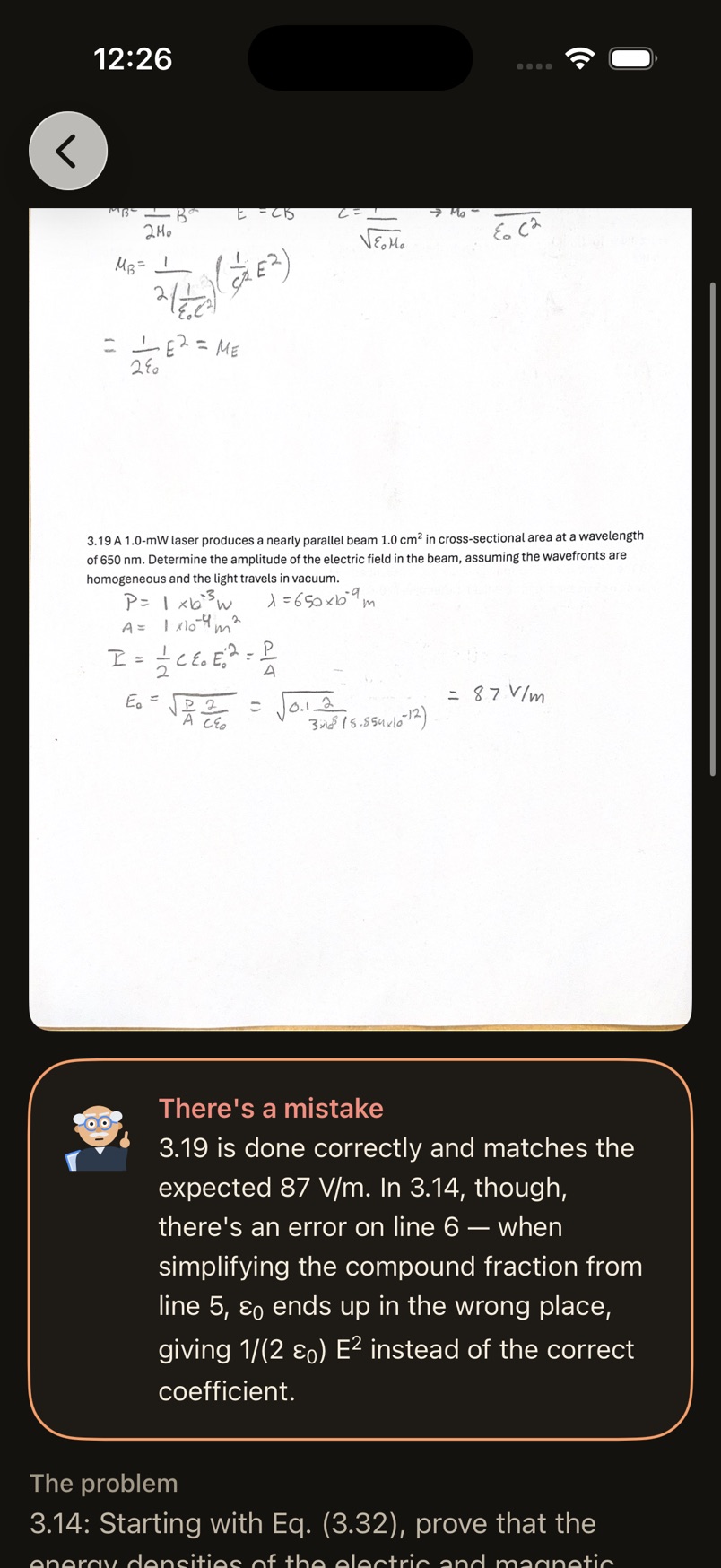
Not a score, and not a red cross at the bottom of the page. He transcribes each step you actually wrote and marks it one at a time: agreed, wrong, or not a step at all. Twelve lines of that problem set were fine. One was not.
Every screenshot on this page comes from the app running on that real problem set — optics and electromagnetism, pencil on lined paper, checked the night this page was written. Below is what he actually said, verbatim.
- 13.14:
- 2uB = 12 μ0 B2
- 3E = cB
- 4c = 1√ε0 μ0 → μ0 = 1ε0 c2
- 5uB = 12×1ε0 c2 × (1c2 E2)
- 6= 12 ε0 E2 = uESimplifying the compound fraction from line 5 should give (ε0/2)E2, but this line has ε0 in the denominator instead.
- 73.19:
- 8P = 1×10⁻³ Wλ = 650×10−9 m
- 9A = 1×10⁻⁴ m2
- 10I = 12 c ε0 E02 = PA
- 11E0 = √PA × 2c ε0
- 12= √0.1×23×108 (8.85×10⁻¹²)
- 13= 87 V/m
Every check also carries a confidence, and a page he judges hard is quietly routed to a stronger model — you never pick the model yourself.
Then he asks you a question back
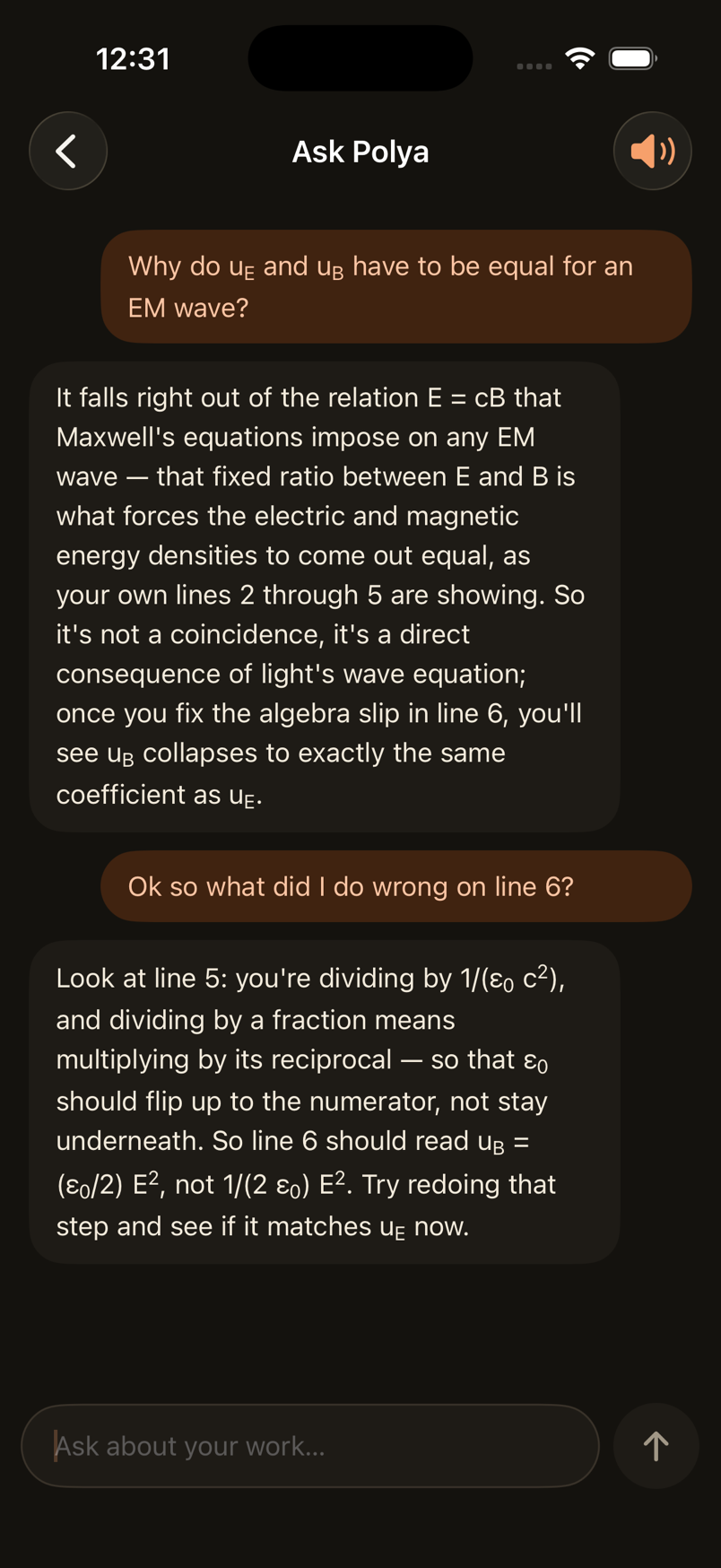
Ask him anything about the page and he answers in the chat — but he remembers what he just marked, and he would rather hand the step back to you than close it. This is the actual exchange after that check: why the two energy densities are equal, then what went wrong on the line he flagged — ending in “try redoing that step”, not in the answer.
Named after George Pólya, who wrote How to Solve It — the book whose whole argument is that the tutor's job is to ask the question the student should have asked themselves.
Or hand him the finished page
You do not have to work in front of him. Photograph a page you finished an hour ago and you get the same thing back — every line transcribed, every step marked, and the one that broke named out loud.
Upload your class's own notes and problem sets and he checks your work against the notation and methods your course actually uses, rather than the way the internet does it.
What he won't do
Worth being blunt about, because it is the reason to use this one rather than the solvers.
- He won't hand you the answer. Even when you ask directly, the reply is a hint and a question. That is the whole design, not a limitation.
- He won't pretend to be certain. Every check carries a confidence, and if he cannot read a line he says so instead of guessing.
- He won't do your typing. Polya reads pencil on paper. If your homework already lives in a text box, you do not need him.
And he won't surprise you with the bill: the planned prices are all written down on the pricing page, including what a credit buys.
Get told when he ships
One email, when there is something to open. No newsletter, nothing sold, and the address is not shared with anyone.